Wednesday, November 4, 2009

Woman selling tajaditas

In this photo you see a woman selling tajaditas, or banana chips.  They are cut length-ways and are much thinner than our banana chips.  They are fried and lightly salted.  They are also served with a lime wedge that you can squeeze on them to make them a little bit softer and to add flavor. 

These two women walked around the medical clinic where we were working and sold small bags of these chips to the people waiting in line.  They are very inexpensive and very good.  It is very common to see women walking around town with a large plastic container like this one full of food for sale. 

(Click on the photograph to see it enlarged in another window.)


Cooking

I recently sorted through my pictures from one of my trips to Honduras.  In this one you see a woman preparing a meal of fish outside.  There are a lot of details here that are very typical of Honduras.

Notice
  • the tables she and the woman in the background are using
  • the two chickens--common pets
  • the woman's genuine smile
  • the large barrel of stored rain water up against the house used for cooking and cleaning
  • the open windows and door--Hondurans are very welcoming people
  • the lack of grass--it's very dry in this region and hard to grow grass
  • the cement block house which was whitewashed that day
  • the plastic chair--these are used at home and in small restaurants
  • the vibrant green trees
  • that you are looking at half the house
(Click on the photograph to see it enlarged in another window.)

Sunday, November 1, 2009

Day of the Dead

The Day of the Dead is celebrated in Mexico on November 1.  It has roots in Aztec religious traditions as well as Catholic influences.  On the holiday it is traditional to remember and celebrate friends and family members who have died by creating an altar for each person.  The altar is not meant to worship the person, but to celebrate his life and to guide his spirit back to the altar to spend the day with friends and family.  An altar generally contains the favorite foods and possessions of the deceased person, as well as traditonal symbolic objects.  Below is a list of the things usually found on an altar and the significance of each one.

tiers of boxes covered with a tablecloth  to display the items attractively

arch  represents the passage from life to death

photo of the person to whom the altar is dedicated   

a glass of water  relieves the thirst of the spirit after a long journey from the other world

fruit and pan de muerto (bread of the dead)  provide nourishment after long travel

one candle at each cardinal direction  to guide the spirit to the house and altar

incense  helps the dead find the altar, represents changing from a physical to a spiritual being

marigolds  represent death, a trail of marigold petals (or the smell of the flowers) guides the soul to the altar

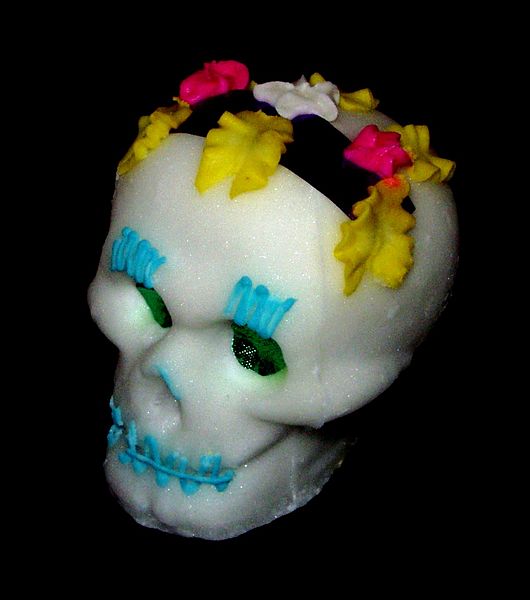
skulls  symbolize death and rebirth

cross  Catholic influence in the religious traditions


RED = blood of life
ORANGE = sun 
YELLOW =  merigolds = flowers of the dead 
VIOLET = pain, suffering, grief, mourning 
PINK = celebration 
WHITE =  purity, hope


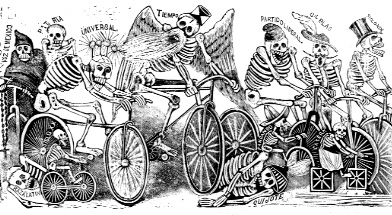
Skulls and skeletons are common decorations of the holiday, but are usually depicted dancing and playing instruments, as it is a happy occasion.  They are often dressed in colorful clothing and with flowers.

You can find many more colorful designs by Googling "Day of the Dead folk art" or "Dia de los Muertos folk art." 


(All photos are public domain or are used according to this agreement:  http://creativecommons.org/licenses/by/2.0/)

Thursday, October 29, 2009

Power Outages

I remember sitting in the living room many times working on homework when the lights went out.  Sometimes they flickered a few times first, giving us time to gather candles and matches.  We always had them ready because we never knew when we would need them.

Not having electricity also meant no hot showers.  It might mean no dinner, if you had an electric stove.  It happened to everyone, and was never an excuse for not having homework done.

Once they were out, we never knew when the lights would be back on.  Sometimes it was only a few minutes.  Other times we went to bed early and woke up to find them back on.  I learned the hard way to use a battery-opperated alarm clock!

Wednesday, October 28, 2009

Widowmakers

In Honduras (and I assume in other Latin American countries as well) hot water is not common.  Most of the time there is a hot water handle on a sink, but nothing comes out. 

The same goes for showers, unless you have an electric shower head, called a widowmaker.  A widowmaker heats up the water before it comes out.  Electricity is required to pump the water to the shower and to heat it.

Without electricity you can take a shower with water from an above-ground cistern.  A cistern is a large tank that catches rain water and holds it for later.  It usually sits above the house so that it can flow straight down inside without the use of electricity.  During the day the water is heated by the sun, making a shower warm, but not hot.  It's good to have a cistern when the electricity goes out, but once the cistern is dry, there is no more water until the next rain.